RV Storage Compartment Security & Lighting
Are your outside compartments—and your gear—actually safe?
Outside accessible storage space is a boon to the modern RVer. Why clutter up your interior storage cabinets when you have basement bays built for all your gear? This compartment is just the right size for that, and that compartment is just made for your new golf clubs...
So says the sales brochure... but...
The Reality of RV Security
Outside accessible storage space is also a boon to the various "low-lifes" and rip-off artists of our society. While thefts from your RV may not be an issue while parked in a crowded RV park, what about the times you are parked in a busy Walmart parking lot? Who would question someone rooting around in a motorhome or trailer storage compartment in a supermarket parking lot? Would you?
Think about what you have stored in those compartments: that $300 fly rod that is too long to fit in the inside closet, your camera gear, the new tool set you just bought, your generator, or a portable barbecue with spare tanks—and on and on.
The Common Key Problem
Did you know that I probably have the keys to your storage compartments in my pocket? A huge number of recreational vehicles on the road in North America—including most older rigs, many budget trailers, and even utility hatches on newer models—still use the exact same 'CH751' key on their exterior storage locks.. Take out your key ring right now and examine your compartment key. Does it have CH751 or ES201 stamped on it? With those keys, you could probably open your neighbor's compartments, the trailer next in line, and so on down the entire row.
And speaking of keys, does your entry door have a locking mechanism with two places to lock the door—one to lock the handle and one to throw the deadbolt? The one that locks the handle is marked with a C or an E and is a universal type of lock.

In other words, my C or E passkey will unlock your trailer if you use only this lock. Every RV salesman, technician, or manufacturer has a passkey for this one lock, and any crook can obtain one with very little difficulty. Always use your deadbolt lock—or better yet, install a keyless entry RV deadbolt lock to eliminate the passkey risk entirely.
Not to say that RV salespeople, technicians, or manufacturers are crooks, of course, but those keys are out there. I also have a key that will fit 90% of all the compartments on most RVs built since 1965—and most of the time, those older compartment locks can be opened with an ordinary screwdriver or a dime.
Physical Vulnerabilities
If I were a thief, anything stored in those compartments could be mine in a matter of seconds. Also, consider that once someone has access to the inside of a compartment, it is an easy matter to lift out the dinette cover, tip up the sofa, or kick in a panel to gain access to the inside of the rig.
Take a good look at your trailer or motorhome and view it as if you had locked your keys inside. Now think of how many ways someone could break in if they weren't worried about causing damage. How about that roof vent? It consists of a plastic lid that can be ripped off, a nylon screen you can poke a finger through, and a 14" x 14" opening to shinny through—with a convenient ladder mounted right on the back of the trailer.
The compartment door itself is usually made of an aluminum frame with a thin sheet of aluminum or fiberglass on the exterior and foam insulation inside. A good swift kick can cave it in, and the locking tab slides into a simple groove on the frame. It doesn't take a rocket scientist to figure out that a flat bar inserted between the frame and the door can pop that lock in seconds. Not exactly Fort Knox, is it?
Upgrading Lock Cylinders, Lighting & Security
You simply have to take an active part in your own security. Making your rig harder and riskier to target is usually all it takes to make a thief move on:
-
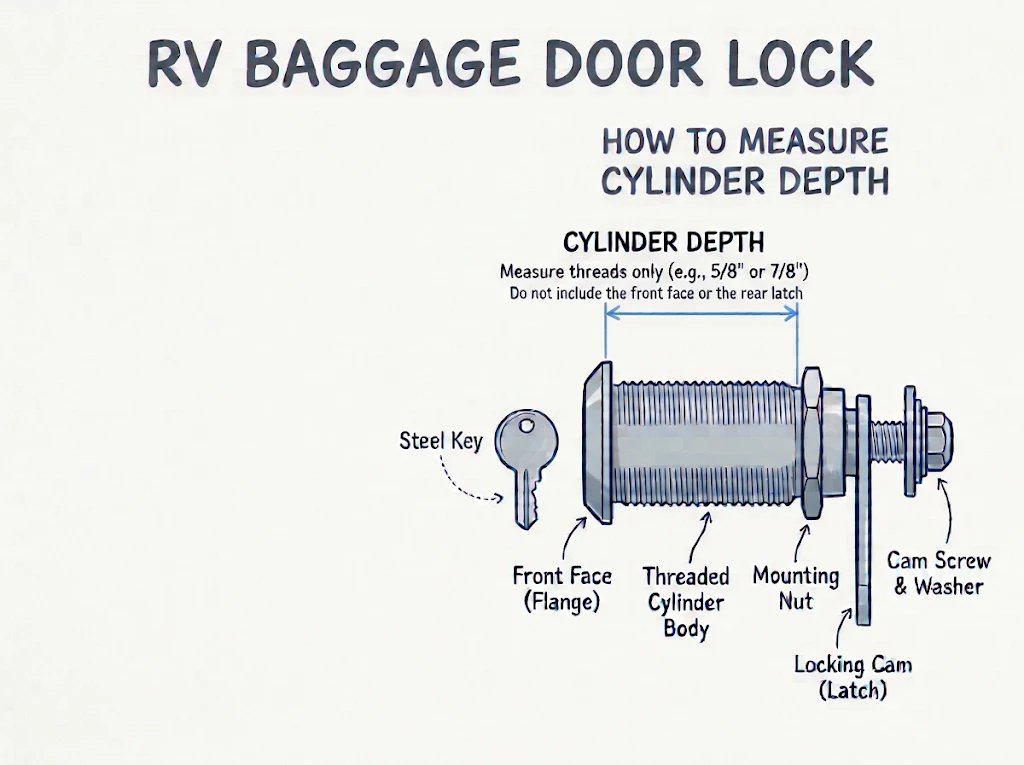
Swap Out Your CH751 Locks: Replace factory baggage locks with pick-resistant tubular cam locks for RV baggage doors that use unique key patterns. Be sure to measure your existing cylinder length (typically 5/8-inch or 7/8-inch) before ordering to ensure a proper fit through your baggage doors.
- Add Motion-Sensor Lighting: Dark basement compartments make locating tools at night difficult—and crooks hate light. Install battery-powered motion sensor LED compartment lights inside baggage bays so they automatically illuminate when doors swing open, and consider exterior motion lights for your campsite.
- Hide Valuables & Add Alarms: Keep high-value items inside and out of sight, preferably in a bolted-down floor safe. Consider adding simple contact alarms to your entry door, windows, and outside compartment doors—and make sure they are L-O-U-D!
Crooks don't like light and they sure don't like noise. Make it tough on them and they'll go elsewhere. Now... don't you feel better?
Security & Maintenance Tip: While you're upgrading your compartment locks, inspect the rubber bulb seals around the baggage door frames. Replacing flattened or cracked seals keeps rainwater from leaking into your basement storage floors during highway driving.
See also:
- Emergency RV Checklist – Essential tools and roadside emergency supplies.
- RV Winter Storage Tips – Moisture control and off-season storage care.